

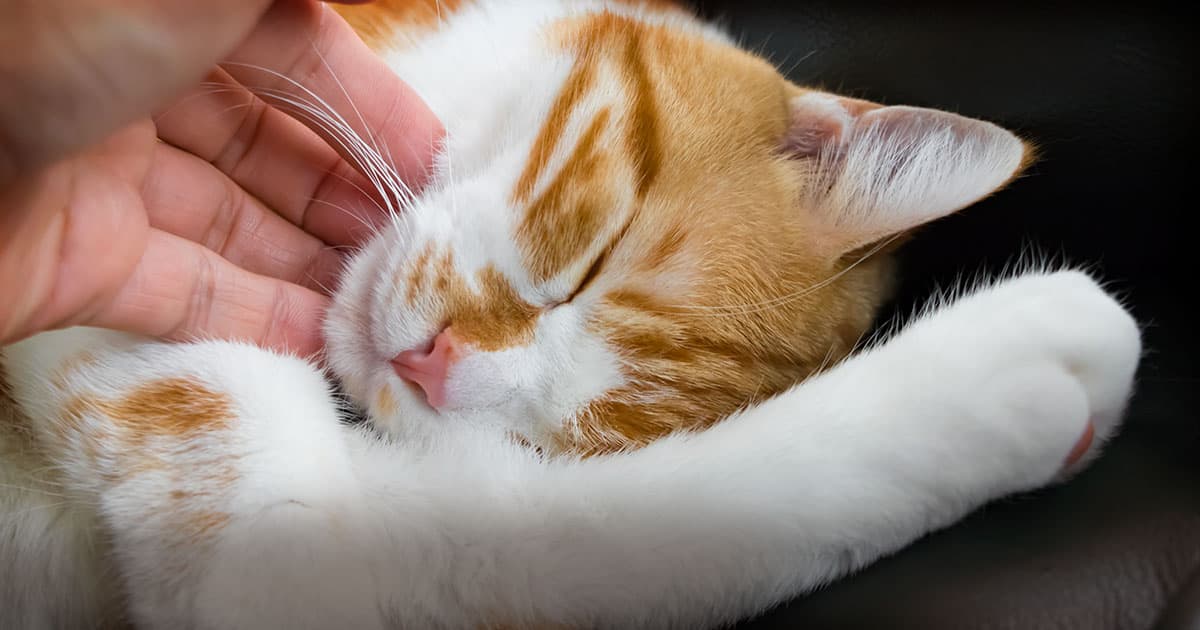
Cat owners love to hear — or feel — their cats purr. There’s something incredibly relaxing and soothing about petting a purring cat while they knead on you. Most people assume a purring cat is a happy cat, but that’s not always true!
Why Do Cats Purr?
Overwhelmingly, cats use purring as a form of communication — with their owners, with each other and with themselves. Many owners are aware that purring is how cats express contentment. However, while purring is often associated with happiness and contentment, it can also signal a range of emotional and physical states, including fear, stress, pain or illness.
Communication
Purring is a cat’s way of talking to humans and other animals. They will often purr to get their owner’s attention, especially when they’re hungry or want a treat; this is a solicitation purr. You might notice a familiar purring sound around mealtime or while you’re in the kitchen preparing food. This purring is usually accompanied by other behaviors, such as rubbing against your legs, following you around or making short meows. It’s their way of saying, “Don’t forget about me, it’s time to eat!”
In multi-cat households, purring can serve to communicate with other cats, such as indicating a desire to play or signaling nonaggression.
Purring for Stress Reduction
The act of purring can be a self-soothing behavior for cats. Many cats purr when they feel fear or distress, and purring may help relieve stress and anxiety. This is why you may notice your cat purring during a veterinary visit; their purring is a way to relieve stress or anxiety in a stressful situation.
Purring can also occur when a cat is sick or nearing the end of life. In these situations, purring may serve as a calming or coping mechanism rather than a sign of happiness.
Coping with Pain by Purring
Cats may also purr when they are experiencing discomfort or pain. Female cats, known as queens, often purr while giving birth as a form of self-comfort and pain management. When cats purr, they release endorphins — feel-good chemicals similar to those released in humans during exercise — which can help manage their pain.
If your cat is purring but showing signs of restlessness, unusually loud or persistent purring, changes in breathing, reduced grooming or reluctance to move in certain ways, it could indicate discomfort or an underlying health issue. If you see signs of discomfort or illness, call your veterinary clinic and schedule a visit.
Purring When Threatened
Purring and other vocalizations can also occur during tense interactions with other cats. Cats may purr in an attempt to soothe themselves, communicate that they do not intend to fight or reduce the other cat’s level of aggression. Similarly, cats may purr around a potential opponent as a way of de-escalating the encounter and preventing the situation from developing into a physical confrontation. Thus, purring can sometimes serve as a form of social communication that helps cats manage conflict and avoid unnecessary aggression.
How Do Cats Purr?
How cats purr has been a mystery for many years. While still a topic of debate, the most common explanation is that a cat’s purr is created when a neural oscillator in their brain intermittently signals the muscles of the larynx (voice box) to vibrate. These vibrations involve the cat’s vocal folds (vocal cords), which rapidly open and close as air moves through the larynx. This is combined with movement of the diaphragm — the muscles at the base of the chest cavity that play an important role in breathing. When air passes over the vibrating vocal folds, a purr is produced as the cat breathes both in and out.
However, one study revealed another possible explanation. Researchers found that domestic cats have “pads” in their vocal folds that allow the folds to vibrate at low frequencies when air passes through.1 This means that purring may not require constant brain signals or active muscle twitching after all — but rather a combination of brain control and physical tissue movement. How cats purr may be one secret that cats keep to themselves!
Do All Cats Purr the Same?
Each cat’s purr is unique. Some are high-pitched; others are low-frequency vibrations. Some cats purr so softly that you feel them vibrate rather than hear them purr, while others purr incredibly loud. Yet despite their uniqueness, research has found that cats purr with a consistent pattern and frequency of about 25 to 150 vibrations per second.2
What’s the big deal about this frequency range? These low frequencies have therapeutic properties — you may have heard of a TENS (transcutaneous electrical nerve stimulation) unit that is used to manage muscle pain. One study recorded a variety of cat purrs, including those of domestic cats, and discovered that the purrs all fit into the vibrational/electrical frequencies used for treating bone fractures, muscle strains, pain, swelling and wounds.2 The author concluded that purring as an internal healing mechanism would certainly be advantageous for cats.
Purr frequencies can go higher than 150 hertz, and it appears the higher frequencies may be used by cats when trying to get their owners’ attention at feeding time. Researchers found that the purr of cats soliciting their owners for food contained a frequency peak of 220 to 520 hertz.3 The authors believe the higher frequency makes the sound harder for cat parents to ignore. Any feline parent will tell you it’s hard to overlook a cat that is purring at dinnertime!
How Do Kittens Use Purring?
When kittens are born, they are blind and deaf, so they rely heavily on their other senses to find their mother. The vibrations of her purr can help guide them toward her body, where they can nurse and stay warm. A mother cat may also purr to reassure her kittens and help them remain close to her.
Kittens purr by the time they’re two days old. It’s thought that purring during nursing lets their mother know they’re okay. Purring is also a bonding mechanism between a kitten and their mother. As kittens grow, they continue to use purring to communicate with their mother, littermates and eventually with people and other animals.
Can Cats Purr in Their Sleep?
Yes, cats can purr while they’re asleep, particularly when they’re relaxed and comfortable. Some cats may continue purring as they drift off or during lighter stages of sleep. Purring may also help cats regulate their breathing. The steady, rhythmic pattern of vibrations can promote calm, regular breathing, which may be especially helpful while they’re resting.
Do All Cats Purr?
Most domestic cats and some exotic cats can purr, but just like humans who may be shy or quiet, individual cats can vary in how often and how loudly they purr. Some cats are very vocal and purr when they are relaxed or want attention, whereas some purr very quietly or rarely purr, making it hard for pet parents to hear them.
Did you know that many wild cats can’t purr? Big cats that can roar, such as lions, tigers and jaguars, don’t have the ability to purr as the vocal cords that produce a roar are not tight enough to produce a purr.
In many ways, a cat’s purr is similar to a human’s smile or laugh or a dog’s wagging tail. It’s a form of communication that can mean different things depending on the context. Paying attention to the circumstances, along with your cat’s body language and behavior, can help you better understand what your feline friend is trying to tell you.
References
1Herbst CT, Prigge T, Garcia M, Hampala V, Hofer R, Weissengruber GE, Janisch C, Fitch WT. Domestic cat larynges can produce purring frequencies without neural input. Curr Biol. 2023;33(21):4727–4732.e5.
2von Muggenthaler E. The felid purr: a healing mechanism? J Acoust Soc Am. 2001;110(5 Suppl):2666.
3McComb K, Taylor A, Wilson C, Charlton BD. The cry embedded within the purr. Curr Biol. 2009;19(13):R507–R508.